 LT HORVÁTH
Reimplementing Local RC With Vimscript
This title may seem strange, so let’s break it down. Reimplementing means implementing again, Local means not remote, RC stands for “Run Commands”, and Vimscript is something to look at if you want to blind yourself.
Fabulous old Vim has an option called exrc (legacy alert!), which allows the execution of a configuration file that is located in the current directory. This is basically poor man’s project-specific configuration. For a time I did not know that this option existed, I had some Vimscript do this dirty work for me: looking for a .vimrc.local file in the current directory and sourcing it.
So I happened to find out about exrc and I was ready to drop my silly little code until I inspected the situation. When exrc option is set a list of files is checked for existence and will be executed without any question or resistance. This is very similar to what I did, but further investigation led me to another option called secure. So big surprise: if you execute files willy-nilly, that is a security concern.
So what is secure?
When on, “:autocmd”, shell and write commands are not allowed in “.vimrc” and “.exrc” in the current directory and map commands are displayed.
– VIM - Vi IMproved 9.1 (2024 Jan 02, compiled May 23 2025 00:48:59)
This poses at least some problems:
- Dude I may want to execute shell commands.
- There can be a version of Vim which has
exrcbut notsecure. - Also Neovim has these options but handles them with a trust mechanism, I want that!
There were multiple versions of this “reimplementation”. First it just read a certain file called .vimrc.local if it were present in the working directory and sourced it. After that I added a prompt to ask the user to trust the file and stored all trusted paths. That raised a problem, trusted files can be changed so they should not be trusted anymore. So in the end I added the hash of the file to the trusted paths. Witness!
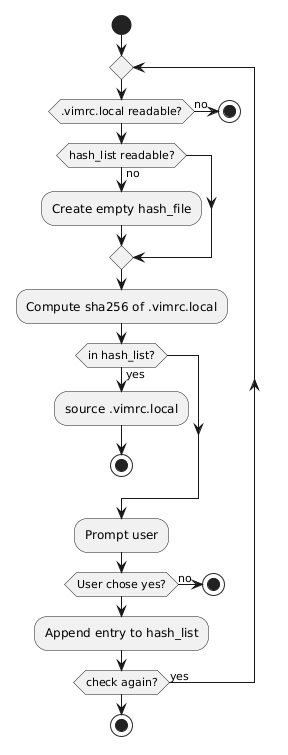
There is a full recursion which is not necessarily necessary, but I find the recursive call expresses a clearer intent in the implementation than an ad-hoc loop. This is not the best choice, but mine.
The hash entries will look like this:
/home/user/workspace/very-nice-project/.vimrc.local|e3b0c44298fc1c149afbf4c8996fb92427ae41e4649b934ca495991b7852b855
/home/user/workspace/never-finished-rust-project/.vimrc.local|1dac7e4ca536b432953d0609a0e8eef8de3607a6e47c5740d58c168ddb881de7
This keeps track of the file path and the hash as well, so if the file changes, the hash will change and the file will not be trusted anymore. This is a simple way to implement a trust mechanism having only a file as storage/state. There is no cleanup, life is hard and short.
Another fun fact is that I used the sha256 function from Vimscript to calculate the hash of the file, not the sha256sum or shasum command from the shell. The reason is that the function implementation is consistent across platforms, while the command is not. That means this solution needs at least Vim 7.4, but what can we do, this is the UNIX wild wild west…
In the end I have the local configuration functionality as I want, yet again without plugins. (At first I wanted to share the script instead of the activity diagram, but you know what big boys say: “That is only an implementation detail. ”)